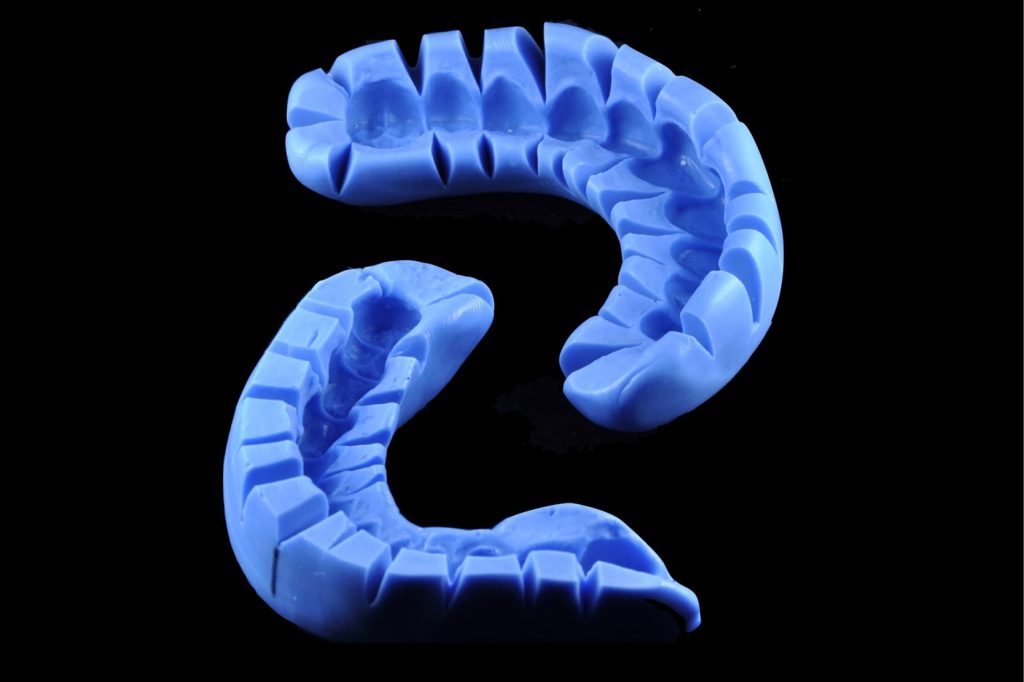
Mock-ups and provisional restorations play an essential role within the clinical and operative workflow of fixed prosthodontics. A mock-up can be described as a temporary intraoral reproduction of the planned prosthodontic result, derived from the diagnostic wax-up, and used to assess aesthetics and function.
Furthermore, having a preview of the work to be carried out significantly increases patient acceptance. Provisional restorations protect prepared teeth, maintain occlusion, and promote healing and soft-tissue modelling during the intermediate stage of treatment. These devices therefore fulfil both a diagnostic and a therapeutic function in complex prosthodontic rehabilitation. (1)
Dental mock-up: aesthetic function and clinical planning
Mock-ups allow the planned restorative outcome to be visualised directly in the oral cavity before irreversible procedures are begun, transferring the information from the diagnostic wax-up, produced by a dental technician, to the patient’s mouth. The mock-up helps guide aesthetic planning, assess functional parameters, and support clinical decisions regarding tooth preparations or surgical procedures. (2)
Clinical studies show that the mock-up is not merely a tool for communicating with the patient, but can also act as a guide for periodontal procedures, such as clinical crown lengthening and soft-tissue remodelling (3), while for the patient it can represent a ‘test drive’ of the definitive restoration. Using the mock-up, the dentist and patient have the opportunity to test the future restoration aesthetically and functionally, and to request any necessary changes from the dental technician.
Mock-ups are produced mainly using bis-acrylic, acrylic, or light-curing composite resin materials. In certain cases, 3D-printed resins may also be used, especially in digital workflows.
Provisional restorations in prosthodontic rehabilitation
Provisional prostheses are temporary restorations placed after tooth preparation and before delivery of the definitive prosthesis. Their main functions include:
- Protection of dental and pulpal tissues from thermal, chemical, and bacterial stimuli
- Maintenance of occlusal relationships and prevention of tooth migration
- Soft-tissue conditioning and emergence profile modelling, especially in the aesthetic region
- Functional and aesthetic evaluation and collection of patient feedback prior to finalisation of the restoration (1)
Materials and techniques for manufacturing provisional restorations
Traditionally, provisional restorations have been made using materials such as polymethyl methacrylate (PMMA) and bis-acrylic composite resins. These materials can be processed using direct, indirect, or semi-direct techniques, often using silicone indices or matrices obtained from diagnostic wax-up. (4)
Digital workflows increasingly involve the use of CAD/CAM systems. These technologies can also be used in the production of mock-ups and provisional restorations.
3D printing enables complex shapes to be reproduced with a high degree of repeatability; digital mock-ups can be modified virtually before clinical application, and can therefore be easily pre-visualized by both dentists and patients. (5) The patient can choose virtually the tooth shape best suited to their aesthetic requirements.
The available evidence shows that 3D-printed provisional restorations exhibit variable mechanical strength depending on the type of resin and printing method, while nevertheless offering a high degree of customisation compared to conventional techniques. (6)
Accuracy and reliability of dental mock-ups and provisional restorations
The marginal and internal fit of provisional restorations directly influences their clinical success. The literature shows that the fabrication method significantly affects accuracy: additive CAD/CAM solutions may provide greater precision in single restorations, while subtractive CAD/CAM techniques may offer better marginal fit in multiple-unit rehabilitations. (7)
Mock-ups also show dimensional differences depending on the technique used for their fabrication. Digital and milled mock-ups exhibit greater fidelity compared to both the diagnostic wax-up and mock-ups created using traditional techniques. (8)
Communication and treatment planning
Mock-ups and provisional restorations represent fundamental tools in clinical communication. A well-executed mock-up helps align patient expectations with treatment goals, improving acceptance of the treatment plan. Additionally, these devices facilitate integration with periodontal, orthodontic and surgical treatments within a prosthetically guided approach. (9)
The use of digital mock-ups has been shown to improve the accuracy of implant planning, allowing prosthetic requirements to be incorporated early in the diagnostic phase. (10)
Limitations and future prospects
Despite their wide clinical use, there are still gaps in the standardisation of provisional-restoration fabrication protocols. Recent studies highlight significant variability in clinical knowledge regarding material selection, fabrication techniques, and the use of digital workflows, underscoring the need for evidence-based guidelines. (11)
Role of mock-ups and provisional restorations in clinical practice
Diagnostic mock-ups and provisional restorations are indispensable tools for achieving predictable prosthetic outcomes. They perform diagnostic, protective, communicative, and therapeutic functions, linking the planning phase to the execution phase.
Digital technologies are improving precision and reproducibility, but clinical judgment remains essential for the appropriate use of these tools. Further research is needed to optimise materials and clinical protocols.
References:
- Heboyan A, Movsisyan N, Khachatryan V. Provisional restorations in restorative dentistry: significance, materials, and considerations. World Science. 2019.
- Reshad M, et al. Diagnostic mock-ups as an objective tool for predictable aesthetic outcomes. Journal of Prosthetic Dentistry. 2008.
- Gurrea J, Bruguera A. Wax-up and mock-up: a guide for anterior periodontal and restorative treatments. International Journal of Aesthetic Dentistry. 2014.
- Regish KM, et al. Techniques of fabrication of provisional restorations. Journal of Prosthetic Dentistry. 2011.
- Systematic review of 3D printing effects on flexural strength of provisional fixed dental prostheses. BMC Oral Health. 2025.
- Systematic review and meta-analysis of 3D-printed provisional restorations. BMC Oral Health. 2024.
- Yılmaz BK, Kızılırmak KT, Ocak M, Tamam E. Micro-CT evaluation of marginal and internal fit of provisional fixed dental prostheses produced with additive and subtractive manufacturing. BMC Oral Health. 2025
- Cattoni F, et al. Milled versus moulded mock-ups based on diagnostic wax-ups. 2019.
- Gurrea J, Bruguera A. Wax-up and mock-up: a guide for anterior periodontal and restorative treatments. International Journal of Aesthetic Dentistry. 2014.
- Esteban MOC, et al. Influence of digital mock-up on dental implant planning accuracy. 2019.
- Elsayed, H. M., Albahkaly, H. S., Samran, A., Noushad, M., Alkheraif, A. A., Alansary, N., & Nassani, M. Z. (2025). Knowledge Gaps and Clinical Practice Patterns in Provisional Fixed Dental Prostheses Among Dentists in Saudi Arabia—A Cross-Sectional, Survey-Based Study. Prosthesis, 7(6), 140.