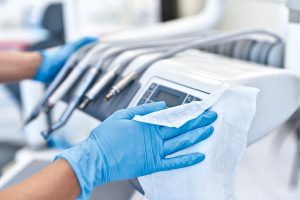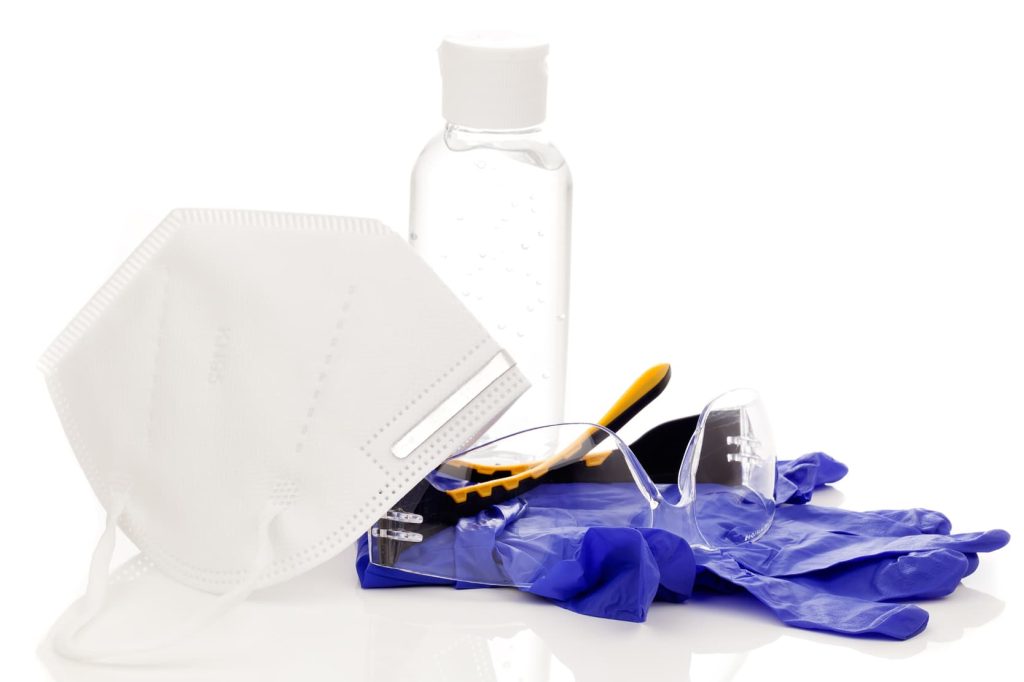
Personal Protective Equipment (PPE) refers to all those barrier measures — gloves, masks, visors/protective eyewear, gowns and additional protective devices — that reduce the exposure of the dental team to potentially infectious biological (blood, saliva, aerosols), chemical (disinfectants, monomers, catalysts) and physical (splashes, particulate matter, dusts) hazards. (1)
In dentistry, the correct use of PPE forms part of the standard precautions and is intended to prevent cross-infections following brief or prolonged contact with skin, mucous membranes, salivary droplets and aerosols generated during routine clinical procedures. (1,2)
Dental impressions, by contrast, are defined as negative reproductions of an object’s surface. (3,4) Over time, dentistry has moved from rigid materials such as impression plaster, impression compound and zinc oxide-eugenol paste to elastic materials such as hydrocolloids and elastomers. (5,6)
Alginate has been, and still is, extremely widely used due to its cost and ease of (7) use, while developments in restorative dentistry and implant prosthodontics have encouraged the use of increasingly accurate elastomers with high tear-resistance and long-term dimensional stability, such as polyvinyl siloxanes (PVS) and polyethers (PE) (8), used to good effect in prosthetic work on natural teeth, implants and edentulous mucosae. (9,10)
When looking at the possible links between PPE and impression materials, two different areas require attention:
- protection of the operator(s);
- the impact of PPE on the clinical outcome.
Personal Protective Equipment (PPE) and impression materials: risks for the clinician
With regard to operator protection, it is important to consider that some impression materials supplied in powder form may contain silica in different forms; in specific formulations, and especially during industrial manufacturing stages, a respirable fraction of crystalline silica (e.g. quartz or cristobalite) may also be present. (11)
However, it should be specified that the risk of occupational exposure to silica-containing dusts concerns industrial settings only, as the extent of exposure in dental practice is markedly lower and no cases of toxicity attributable to this type of exposure have ever been recorded in dentistry. (11,12)
Sensible practices that can reduce this risk almost completely include a few simple precautions:
- avoid sudden dispersal of powder (‘dust puff’) by opening bags or containers slowly and in a controlled manner;
- wait a few seconds after any mixing movements of the container to allow the particles to settle;
- assess the adequacy of ventilation and ambient extraction in the mixing area;
- When handling powder, use respiratory protection commensurate with the risk: at least a correctly worn surgical mask, and preferably an FFP2 filtering facepiece respirator.
PPE and addition-cured silicones: possible interference with latex
With regard to the influence of PPE on the clinical outcome, attention should be drawn to the relationship between addition-cured silicones and the use of latex gloves. These materials polymerise through a platinum-catalysed system; trace amounts of sulphur-containing compounds can interfere with the catalyst, resulting in partial or temporary inhibition of polymerisation.
This interference may prolong setting times or lead to incomplete polymerization, with the risk that the impression is removed from the oral cavity before the full development of its final mechanical properties, thereby compromising its accuracy. (13)
Experimental studies have shown that some gloves (especially latex gloves and, in certain cases, even latex-free products containing specific additives) may interfere with PVS setting when direct contact occurs during handling or mixing. (14,15)
Good working habits in this respect may include:
- avoid kneading PVS putty while wearing latex gloves;
- prefer nitrile or vinyl gloves (or alternatives specified by the PVS manufacturer);
- if contamination is suspected (haemostatic agents, latex, etc.), it is better to repeat the impression stage, trying to eliminate as many factors as possible that could inhibit polymerisation of the material.
PPE in impression disinfection and splash protection
Further links between PPE and impression materials relate to impression disinfection and protection from splashes during mixing and from the “snap” of impression removal. All dental impressions must be disinfected after being taken, owing to the risk of cross-infections between the dental practice and the laboratory. (16) However, impression disinfectants may themselves be irritant to the skin and mucous membranes, so gloves, protective eyewear/a visor and a gown musttherefore be worn during the procedure. (17)
Another risk factor, often underestimated with impression materials, involves minor incidents caused for example by vigorous mixing, spatulation or removal of the impression with splashes of saliva or disinfectant. As a precaution against these uncommon but possible events, the use of eye protection with side shields or a visor is therefore recommended whenever splashes or spray are likely.
PPE and impression materials in clinical practice
In conclusion, PPE is not merely a means of protecting the clinician, but is fully embedded into the correct clinical protocol for using impression materials.
Knowledge of the potential interactions between PPE and materials, as well as the risks associated with their handling, helps reduce preventable occupational exposure and prevent clinical errors that may compromise impression accuracy. The informed use of appropriate protective equipment, together with simple good working practices, therefore helps improve both the safety of the dental team and the quality of the clinical result.
References:
1. Gund MP, Naim J, Rupf S, Gärtner B, Hannig M. Bacterial contamination potential of personal protective equipment itself in dental aerosol-producing treatments. Odontology. 2024 Apr;112(2):309–16.
2. Patil S, Moafa IH, Bhandi S, Jafer MA, Khan SS, Khan S, et al. Dental care and personal protective measures for dentists and non-dental health care workers. Dis Mon. 2020 Sept;66(9):101056.
3. The Glossary of Prosthodontic Terms 2023: Tenth Edition. J Prosthet Dent. 2023 Oct;130(4 Suppl 1):e1–3.
4. Papadiochos I, Papadiochou S, Emmanouil I. The Historical Evolution of Dental Impression Materials. J Hist Dent. 2017;65(2):78–89.
5. Punj A, Bompolaki D, Garaicoa J. Dental Impression Materials and Techniques. Dent Clin North Am. 2017 Oct;61(4):779–96.
6. Donovan TE, Chee WWL. A review of contemporary impression materials and techniques. Dent Clin North Am. 2004 Apr;48(2):vi–vii, 445–70.
7. Cervino G, Fiorillo L, Herford AS, Laino L, Troiano G, Amoroso G, et al. Alginate Materials and Dental Impression Technique: A Current State of the Art and Application to Dental Practice. Mar Drugs. 2018 Dec 29;17(1):18.
8. Baldissara P, Koci B, Messias AM, Meneghello R, Ghelli F, Gatto MR, et al. Assessment of impression material accuracy in complete-arch restorations on four implants. J Prosthet Dent. 2021 Dec;126(6):763–71.
9. Grande F, Pavone L, Molinelli F, Mussano F, Srinivasan M, Catapano S. CAD-CAM complete digital dentures: An improved clinical and laboratory workflow. J Prosthet Dent. 2025 June;133(6):1430–5.
10. Walker MP, Alderman N, Petrie CS, Melander J, McGuire J. Correlation of impression removal force with elastomeric impression material rigidity and hardness. J Prosthodont. 2013 July;22(5):362–6.
11. Ardit M, Baroni T, Capacci F, Arcangeli G, Romanelli M, Zoleo A, et al. Possible hazardous components in dental alginates: Physicochemical properties by a mineralogical and spectroscopic investigation. Hygiene and Environmental Health Advances [Internet]. 2023 Dec [cited 2025 Dec 18];8:100083. Available from: https://linkinghub.elsevier.com/retrieve/pii/S2773049223000399
12. Barbieri PG, Somigliana A, Carradori G. Silicosi severa da terre di diatomee nella produzione di alginato ad uso odontoiatrico: uno studio necroscopico. Med Lav. 2020 June 26;111(3):222–31.
13. de Camargo LM, Chee WW, Donovan TE. Inhibition of polymerization of polyvinyl siloxanes by medicaments used on gingival retraction cords. J Prosthet Dent. 1993 Aug;70(2):114–7.
14. Walid Y, Al-Ani Z, Gray R. Silicone impression materials and latex gloves. Is interaction fact or fallacy? Dent Update. 2012;39(1):39–42.
15. Ravikumar CM, Sangur R. Effect of five brands of latex gloves on the setting time of polyvinyl siloxane putty impression materials. Indian J Dent Res. 2012;23(2):209–12.
16. Hardan L, Bourgi R, Cuevas-Suárez CE, Lukomska-Szymanska M, Cornejo-Ríos E, Tosco V, et al. Disinfection Procedures and Their Effect on the Microorganism Colonization of Dental Impression Materials: A Systematic Review and Meta-Analysis of In Vitro Studies. Bioengineering (Basel). 2022 Mar 16;9(3):123.
17. Connor C. Cross-contamination control in prosthodontic practice. Int J Prosthodont. 1991;4(4):337–44.